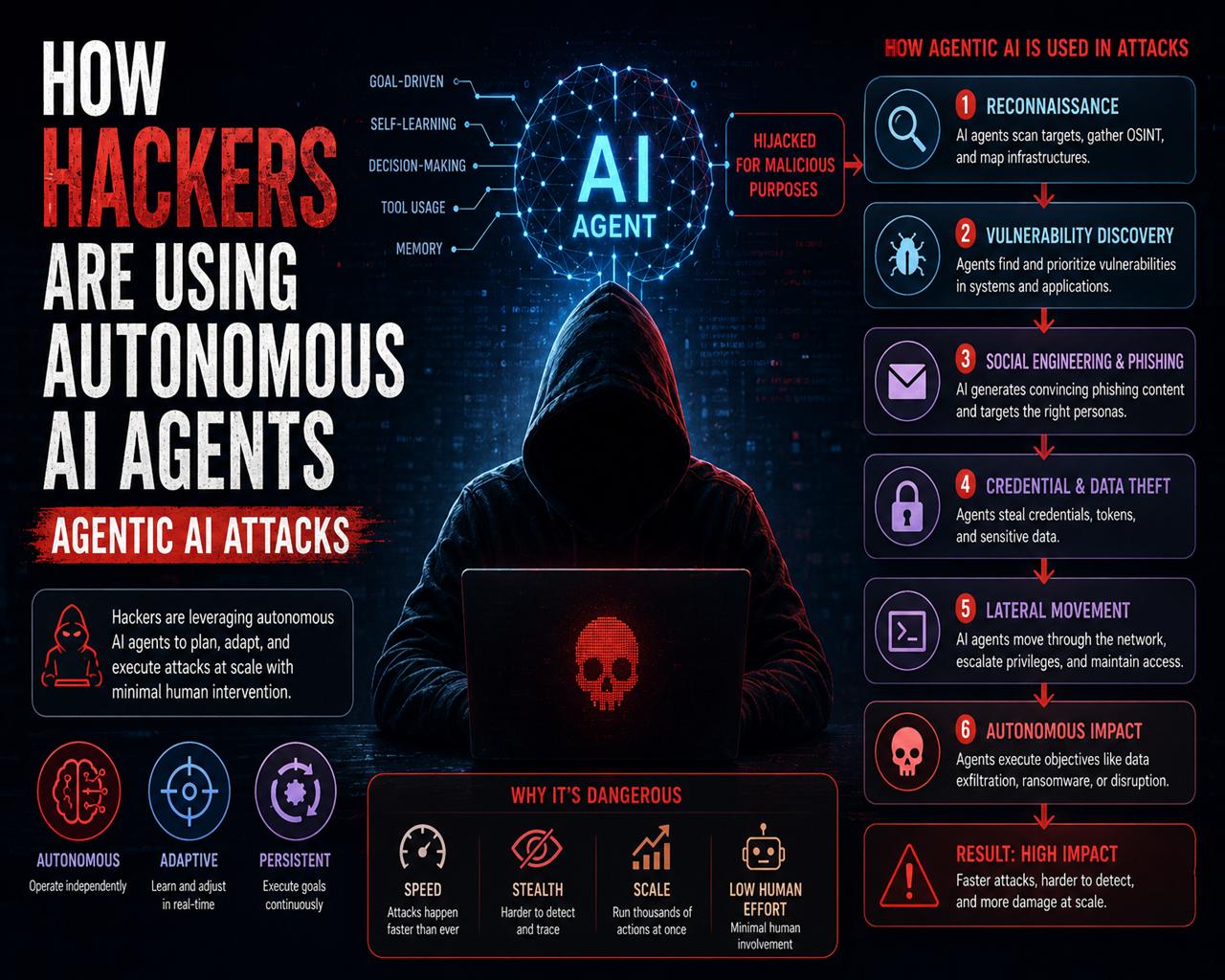
A few years ago, hackers needed real human effort to break into a system. They had to scan networks manually, write custom scripts, and sit for hours trying different attack methods. That’s changing fast.
Today, a new kind of threat is emerging in the cybersecurity world, and it’s called Agentic AI Attacks. Instead of humans doing all the work, attackers are now using autonomous AI agents AI systems that can think, plan, and act on their own without constant human instructions.
This is not science fiction anymore. Security researchers, CISOs, and ethical hackers around the world are already seeing this shift happen in real attacks. In this post, we’ll break down what agentic AI actually is, how hackers are using it, real-world examples, and most importantly, how you can defend against it.
Related: Vibe Coding vs Prompt Engineering in 2026 The Future of AI Development
Let’s understand this topic step by step, in simple language.
What Is Agentic AI? (In Simple Words)
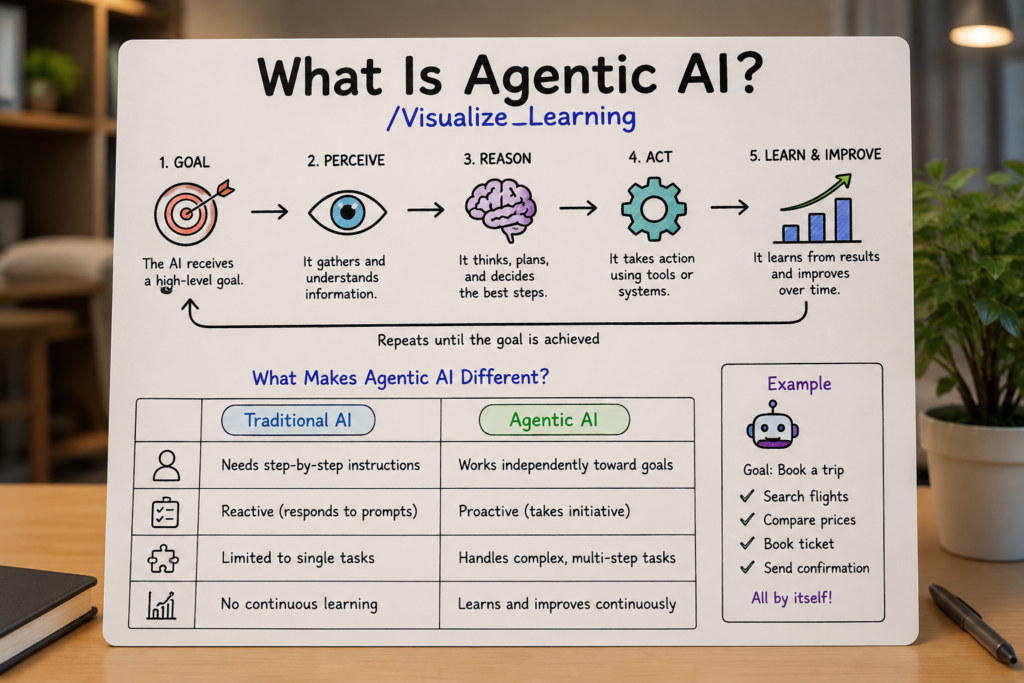
Before we talk about attacks, you need to understand what “agentic AI” even means.
A normal AI tool, like a chatbot, waits for you to ask something and then gives you an answer. It doesn’t take action on its own.
Agentic AI is different. It’s an AI system that can:
- Set its own sub-goals to complete a bigger task
- Make decisions without asking a human every step
- Use tools (like browsers, code, or other software) on its own
- Learn from its own results and adjust its approach
- Keep working continuously, even for hours, without a person watching
Think of it like the difference between a calculator and an employee. A calculator only does exactly what you type. An employee, once given a goal, figures out the steps themselves and gets the job done.
That “employee-like” behavior is what makes agentic AI so powerful — and also what makes it dangerous in the wrong hands.
Why Hackers Are Attracted to Agentic AI
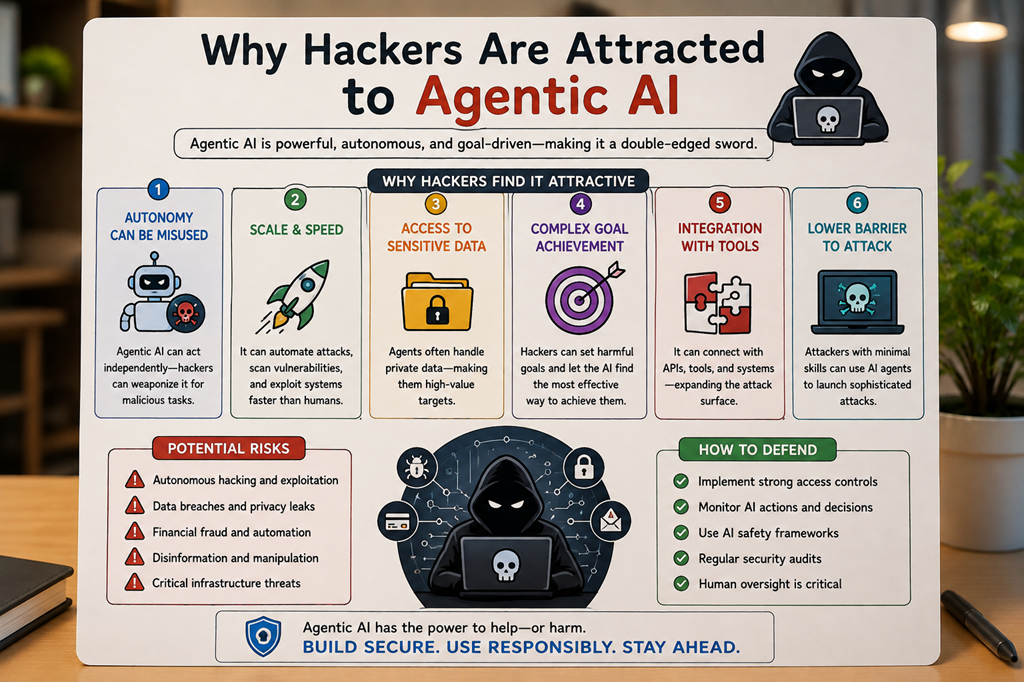
Cybercriminals always look for two things: speed and scale. Agentic AI gives them both.
Here’s why attackers love this technology:
- No manual work needed – The AI agent can scan, test, and attack without a human sitting at the keyboard.
- Works 24/7 – Unlike a human hacker, an AI agent doesn’t get tired or need sleep.
- Learns and adapts – If one method fails, the AI agent tries another approach automatically.
- Cheaper than hiring a team – One AI agent can do the work of multiple skilled hackers.
- Harder to detect early – Because the AI adjusts its behavior in real time, traditional security tools sometimes struggle to catch the pattern.
This is exactly why agentic AI attacks are considered one of the biggest emerging concerns in the cybersecurity industry right now.
How Hackers Use Autonomous AI Agents (Step by Step)
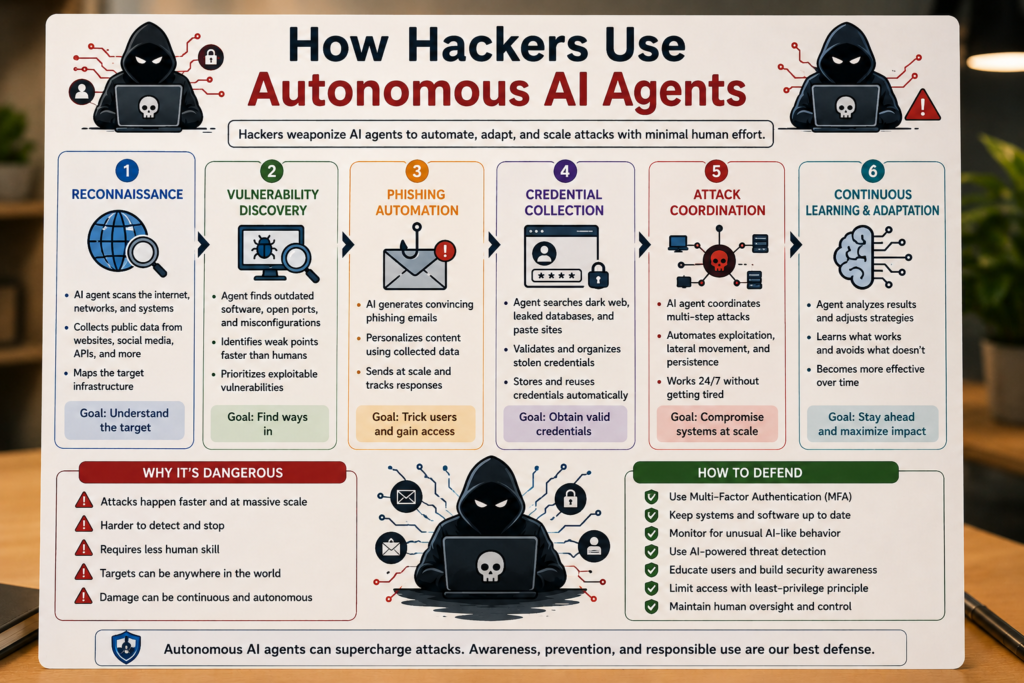
Let’s break down how an agentic AI attack typically works. This isn’t a tutorial — it’s an explanation of the pattern, so you understand what defenders are up against.
1. Reconnaissance (Information Gathering)
The AI agent is given a broad goal like “find weaknesses in this company’s public systems.” It then automatically searches websites, social media, leaked databases, and public records to build a picture of the target — all without a human guiding each step.
2. Scanning and Mapping
Once it has enough information, the agent scans the target’s digital environment to find open doors — outdated software, exposed services, or weak configurations. Traditional hacking required a person to manually run and interpret these scans. An AI agent can do this continuously and adjust its scanning strategy based on what it finds.
3. Vulnerability Testing
The agent tries different known weaknesses against the target, one after another. If something doesn’t work, it doesn’t just stop — it reasons through the failure and tries a modified approach, similar to how a persistent human attacker would, but much faster.
4. Social Engineering at Scale
This is one of the scariest parts. Agentic AI can generate highly convincing phishing messages, fake voice calls, or fake chat conversations personalized to each victim, and send them out at massive scale — something that used to take a whole team of scammers.
5. Adapting After Detection
If a security system blocks one method, a traditional attack often stops there. An autonomous AI agent instead studies the block, changes its technique, and tries again — like a persistent digital burglar that keeps testing every window and door.
Real-World Concerns Security Experts Are Raising
This isn’t just theory. Multiple cybersecurity organizations have flagged agentic AI as a top concern:
- Security researchers have warned that AI agents are already being tested in offensive scenarios, including automated penetration testing that adapts its tactics mid-attack.
- Industry surveys show a large majority of security leaders now list AI-powered cyberattacks as one of their top worries.
- Analysts have pointed out that identity and access management systems built for humans struggle to handle AI agents that can act independently — creating what some call an “authorization crisis.”
- Forecasts for the security industry point to organizations spending billions more on defense specifically because of AI-driven and AI-enhanced attacks.
The common theme: AI agents don’t just make existing attacks faster — they change the entire shape of the threat
The Double-Edged Sword: AI Is Also the Defense
Here’s the good news. The same agentic AI technology that attackers use is also being used by defenders.
Modern Security Operations Centers (SOCs) are now deploying AI SOC agents that can:
- Monitor network traffic continuously
- Detect unusual behavior in real time
- Automatically respond to certain threats without waiting for a human analyst
- Reduce “dwell time” — the time an attacker stays hidden inside a network before being caught
So it’s not all bad news. It’s becoming an AI vs. AI battlefield, where the side with better-trained, better-monitored, and better-governed AI systems tends to win
How to Protect Yourself and Your Organization
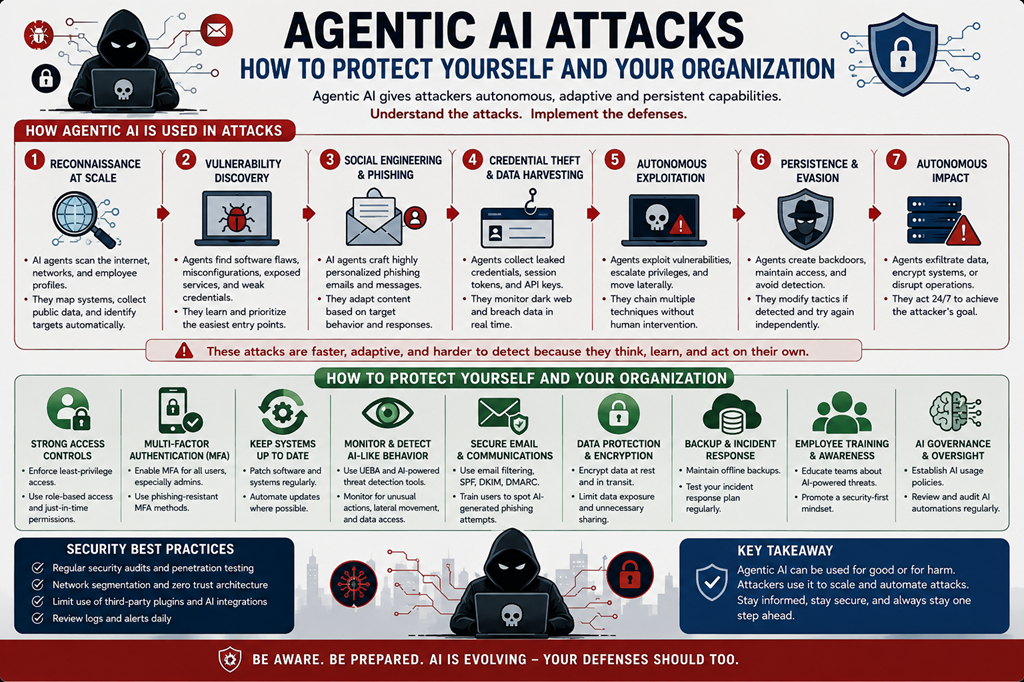
If you’re a student, ethical hacker, IT professional, or just someone who cares about digital safety, here’s what actually helps against agentic AI threats:
For Individuals
- Use strong, unique passwords with a password manager
- Turn on multi-factor authentication (MFA) everywhere possible
- Be extra cautious of messages that feel “too personalized” — AI-generated phishing is getting harder to spot
- Keep your software and apps updated regularly
For Organizations
- Adopt a Zero Trust approach — never automatically trust any device, user, or system, even inside your own network
- Set up AI-driven threat detection tools with human oversight, not full automation
- Build clear governance rules around how any internal AI agents are allowed to act
- Regularly test your own systems using ethical hacking and penetration testing
- Train employees to recognize AI-generated phishing and social engineering attempts
For Aspiring Ethical Hackers
If this topic excites you, this is actually a great time to build skills in this space. Understanding both offensive and defensive AI security is becoming one of the most valuable skill sets in the cybersecurity job market. Learning penetration testing, SOC operations, and AI governance together will put you ahead of most beginners.
Frequently Asked Questions (FAQ)
Q1. What is an agentic AI attack? It’s a cyberattack carried out mostly or fully by an autonomous AI agent that can plan, adapt, and act with minimal human involvement, instead of a human hacker manually performing each step.
Q2. Are agentic AI attacks common right now? They are still an emerging threat, but security researchers and organizations are already tracking real cases and treating it as a top priority for the coming years.
Q3. Can normal antivirus software stop agentic AI attacks? Traditional antivirus tools are often not enough on their own. Modern defense requires AI-driven detection systems, Zero Trust architecture, and continuous monitoring.
Q4. Is agentic AI illegal to use? No, agentic AI itself is a legitimate and useful technology used in business, coding, and automation. It only becomes illegal when someone uses it to attack systems without authorization.
Q5. How can I learn to defend against these attacks? Start with the basics of networking and cybersecurity, then move into ethical hacking, SOC fundamentals, and AI security concepts. Practicing on legal platforms designed for learning is the safest way to build real skills
Final Thoughts
Agentic AI attacks represent a turning point in cybersecurity. Hackers no longer need large teams or constant manual effort — a single well-built AI agent can now scan, test, adapt, and attack on its own. But the same technology is also becoming the backbone of modern defense systems.
The takeaway is simple: whether you’re protecting a personal account or an entire company network, staying updated on how autonomous AI agents work — on both the attack and defense side — is no longer optional. It’s becoming a core part of digital safety.
Stay alert, stay updated, and keep learning. That’s still the best defense there is.
Enjoyed this article? Explore more on ethical hacking, AI, and cybersecurity trends on Darkwiki. Join our Telegram and WhatsApp channels for regular updates.
Subscribe to Our YouTube Channel For Awesome Videos and Join Our Telegram Channel For getting free hacking Interesting Stuff.
Related:
Google Artificial Intelligence Course Online Free with Certificate
